Pilatus invests $123M in Swiss composites facility, and five other moves this week
PeakJet launches semi-private aviation in Europe; Berkshire Hathaway increases Delta stake as NetJets limits sales; Burke Lakefront Airport faces closure fight.
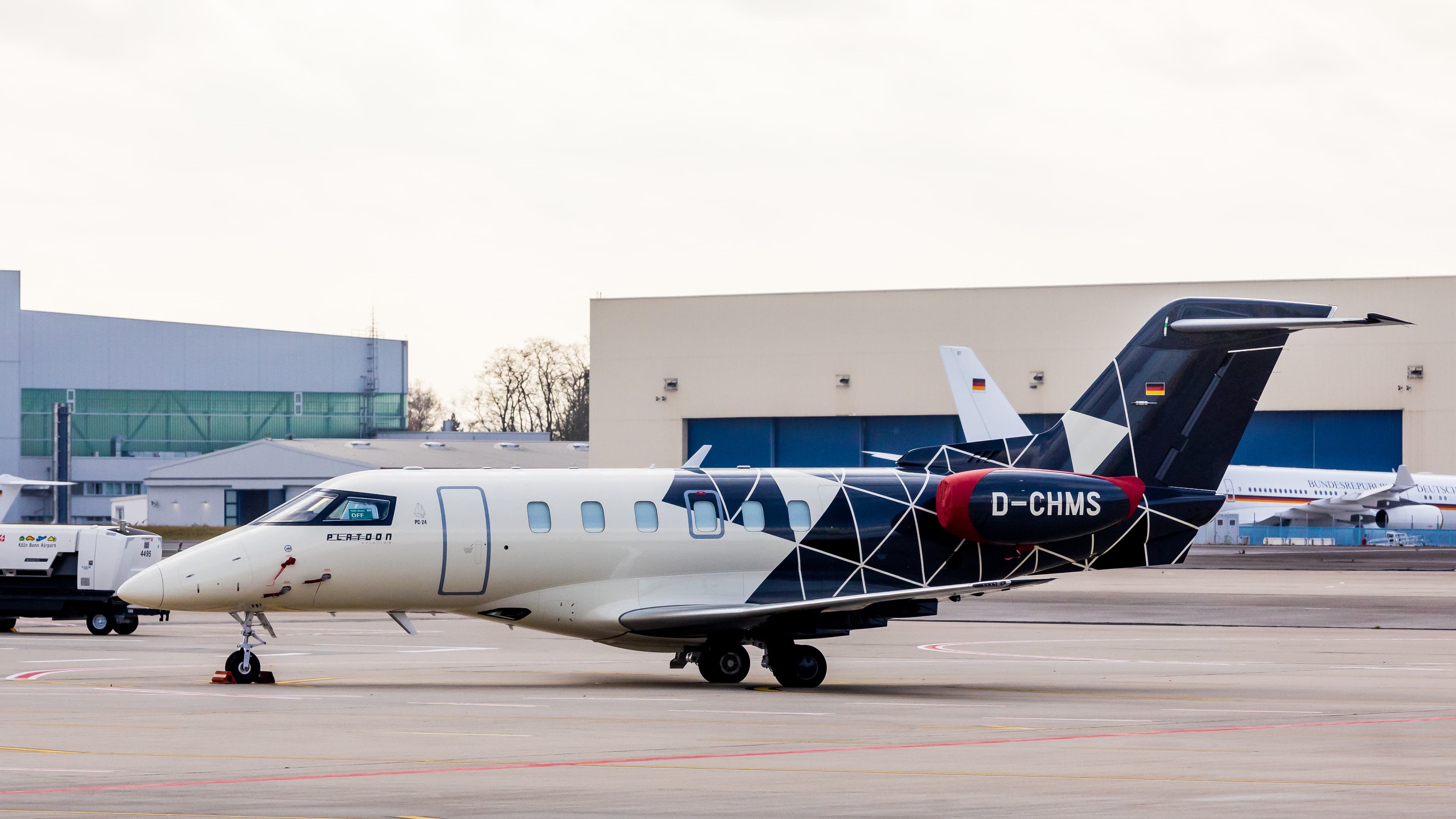
Pilatus Aircraft has opened a $123 million composite manufacturing facility in Switzerland, its largest single investment to date. The move signals an industry-wide shift toward lighter materials as business jets aim to reduce weight and fuel consumption. Separately, a Swiss startup has launched Europe's first semi-private aviation platform, while changes in the US fractional and charter market have left operators rethinking their strategies.
Pilatus opens $123M composite manufacturing center
The new Schwarzhorn facility in Nidwalden brings Pilatus' composite development and production operations together under one roof for the first time. The building, which cost CHF 100 million, provides workspace for about 300 employees and handles the full production process from raw material delivery through component manufacturing, subassembly and surface treatment.
Pilatus CEO Markus Bucher said the project represents the company's largest investment in a single new facility to date. Pilatus has used fibre-reinforced composites for more than 40 years, but their use was traditionally limited to non-load-bearing parts. That changed with the PC-24 twinjet, which uses composites in primary structures including load-bearing control surfaces.
The lighter structures help reduce aircraft weight and fuel consumption. The facility was designed to accommodate new production and inspection technologies and greater automation in the future. Bringing engineering and manufacturing teams into the same facility is intended to improve cooperation. The building incorporates photovoltaic panels and uses waste heat from production processes and groundwater for heating and cooling. Pilatus is seeking LEED Platinum certification, which would be a first for the company.
PeakJet launches semi-private aviation platform in Europe
PeakJet, a Swiss startup set up by experienced airline executives, completed its first flight on 1 August 2026, coinciding with Switzerland's national day. The flight operated between Zurich and Palma de Mallorca using an Embraer 650 Legacy provided by VistaJet Gmbh, the German subsidiary of the executive aviation group.
The startup does not hold its own air operator certificate. Instead, it acts as a platform defining the value proposition and deploying capacity to markets with latent demand for semi-private service. The business model is asset-light and designed to scale easily.
Gianni Tronza, a Swiss executive with senior roles at Etihad Airways, American Airlines, British Airways and Crossair, leads the project. Peter Baumgartner, former CEO of Etihad Airways, also backs the venture. Tronza said he was particularly inspired by Aero, a US semi-private carrier serving upmarket leisure destinations. The founders noted that private jets operate only 40% of the time on average, leaving available capacity in the executive aviation market.
Berkshire Hathaway increases Delta stake as NetJets tightens access
Berkshire Hathaway increased its stake in Delta Air Lines by 44% in the second quarter. The holding climbed to 57.3 million shares, valued at about $5.4 billion at the end of June. Berkshire had returned to investing in the scheduled airline industry earlier in the year with a Delta stake valued at $2.6 billion.
Delta owns 36% of Wheels Up, the private jet company, making it the largest shareholder. The airline bought that stake after selling Delta Private Jets to Wheels Up in 2019. Delta led a $500 million investment to save Wheels Up from potential bankruptcy in 2023, and has backed $332 million of financing via Bank of America for Wheels Up's fleet update in 2024. Wheels Up retired the last of its legacy fleet earlier this year and is currently operating Phenom 300 light jets and Challenger 300 super-midsize jets. It ranks as the fourth-largest US private jet operator measured by charter and fractional flight hours.
Meanwhile, NetJets, which leads the industry in charter and fractional fleet flight hours with more than double the flight hours of second-place Flexjet, recently curtailed sales of both jet cards and leases to new clients. It was the second time in five years NetJets limited sales. Its aircraft management arm, Executive Jet Management, scrapped its guaranteed jet card during the Covid surge and has yet to bring it back. Flexjet generates over $750 million in annual revenue through its Sentient Jet and FXAir brokerages.
Cirrus SF50 undercuts charter rates
The Cirrus SF50 Vision Jet, a single-engine, single-pilot very-light-jet, undercuts charter rates by over $1,000 per hour. The aircraft is designed more similarly to turboprops than to other very-light-jets and sits at the bottom of the business jet market in terms of size and price.
Burke Lakefront Airport closure opposed
The Federal Aviation Administration and Ohio's US senators have explicitly opposed the closure of Burke Lakefront Airport. The National Business Aviation Association applauds the FAA and Ohio senators for their decisive opposition to the closure plan. The reporting does not say what prompted the closure proposal or what the timeline for any decision is.
Beechcraft Baron offered for sale
A 1975 Beechcraft Baron B55 is available for $265,000. The aircraft has 5,635 hours on the airframe, with 375 hours since overhaul on each of its 260 hp Continental IO-470 engines and 375 hours since overhaul on its three-blade scimitar propellers. It has a 1,542-pound useful load and 136-gallon usable fuel capacity. The panel includes Garmin GTN 750Xi and GTN 650 GPS/Nav/Coms, dual Garmin G5 instruments, PS Engineering PMA 450B, Garmin GTX 345 transponder with ADS-B In and Out, WX 500 Stormscope with weather mapping, and S-TEC 3100 autopilot. The aircraft includes Baron-specific flight instruction in the sale price.
What it means
The stories this week reflect two distinct currents in the market. First, infrastructure investment and manufacturing capability are shifting to serve medium-term demand. Pilatus' $123 million facility bet assumes steady demand for the PC-24 and future composites-heavy aircraft; PeakJet's launch assumes sustainable demand for premium-priced semi-private flying in Europe.
Second, consolidation and access restrictions are reshaping the fractional and charter landscape in the US. Delta's deepening stake in Wheels Up, combined with NetJets' second sales closure in five years, suggest the fourth-largest operator and the largest are playing different games: Delta is building capacity and cross-selling opportunity; NetJets is managing demand by rationing supply. For charter buyers, that means fewer options at the premium end and increased reliance on Wheels Up, at least until NetJets reopens sales again.
The other stories—a $265,000 used Baron, a FAA defence of a regional airport, and a very-light-jet undercutting charter—represent the market's persistent fragmentation. Business aviation remains several markets at once, not one.